Showing posts with label shrimp. Show all posts

Friday, January 17, 2014

Stir-Fried Fennel and Pink Grapefruit with Shrimp (FM)

  • 3 tablespoons vegetable or olive oil
  • 1 bunch scallions, cut into 1-inch pieces
  • 1 tablespoon minced garlic
  • 1 tablespoon minced ginger
  • 1 fresh hot chile (like jalapeno or Thai), minced [Somehow flaked of this.  Use red chile flakes instead.]
  • 2 large fennel bulbs, cored and thinly sliced
  • 2 grapefruit, peeled, segmented, and chopped [Bittman says that if you know how to supreme citrus, you should go ahead and I did.  Don't typically have much practice at this.]
  • 8 ounces shrimp, peeled
  •  1 tablespoon soy sauce, or to taste
  • 1/4 cup chopped fresh mint, cilantro, or a combination
  • Salt and black pepper
Mise en place.

Heat oil over high heat.  Cook scallion, garlic, ginger, and chile for a couple of minutes.  Then add fennel and another couple of minutes.

Add grapefruit, shrimp, and soy sauce.  Cook until shrimp are uniformly pink.  Basically another couple of minutes.

A decent stir-fry.  My one objection:
Where the hell is the grapefruit?  Kept eating the damn thing and nothing about it ever screamed grapefruit to me.  If you're going to supreme the grapefruit, maybe doubling the amount might fix this.  As it is, it can't really stand up against 2 large fennel bulbs.

Shrimp Fra Diavolo (CI)

from Cook's Illustrated, February 2014
  • 1 1/2 pounds large shrimp (26 to 30 per pound), peeled and deveined, shells reserved
  • Salt
  • 1 (28-ounce) can whole peeled tomatoes
  • 3 tablespoons vegetable oil
  • 1 cup dry white wine
  • 4 garlic cloves, minced
  • 1/2-1 teaspoon red pepper flakes
  • 1/2 teaspoon dried oregano
  • 2 anchovy fillets, rinsed, patted dry, and minced
  • 1/4 cup chopped fresh basil
  • 1/4 cup chopped fresh parsley
  • 1 1/2 teaspoons minced pepperoncini, plus 1 teaspoon brine
  • 2 tablespoons extra-virgin olive oil
Tomatoes into colander set over bowl.  Pierce tomatoes with spatula and stir around to release juice.  Do not wash colander.

Mise en place.  The shrimp was tossed with 1/2 teaspoon of salt.

Heat 1 tablespoon vegetable oil over high heat until shimmering.  Cook shrimp shells until they begin to brown.

Add wine and let bubble away until reduced to 2 tablespoons.

Add reserved tomato juice and simmer to meld flavors.

Strain "stock" and discard shells.

Heat remaining oil, garlic, pepper flakes, and oregano over medium heat until garlic is straw-colored and fragrant.
Add anchovies and cook to the same effect.

Off heat, add tomatoes and mash with potato masher until coarsely pureed.  Stir reserved juice mixture in and return to medium-high heat.  Simmer until thickened.

 
Add shrimp and simmer gently until just cooked through.
Remove from heat.  Stir in basil, parsley, and pepperoncini and brine and season with salt and pepper to taste.

The shrimp fra diavolo can be served with salad and crusty bread, but spaghetti serves my purposes better.
The dish was pretty good and certainly not some straight-forward and pedestrian "rubbery seafood in spicy marinara."  The use of shrimp shells built a huge background of shrimp flavor that would've been impossible if it wasn't there.  Unless, of course, one overcooked the shrimp; which this dish avoided, except for when I went to reheat the leftovers.

Saturday, November 23, 2013

Chipotle Quinoa with Corn and Black Beans and Shrimp (FM)

  • 3 tablespoons olive oil
  • 1 onion, chopped
  • 1 tablespoon minced garlic
  • 2 (or more) canned chiles, minced, with some of their adobo sauce
  • 1 tablespoon chopped fresh oregano, or 1 teaspoon dried [I used Mexican oregano since I have it and this is a Mexican dish]
  • 3/4 cup quinoa, rinsed and drained
  • Salt and black pepper
  • 1 cup cooked or canned black beans, drained
  • 1/2 cup corn kernels (frozen are fine)
  • 1 1/2 cup vegetable stock, beer, [I had an odd bottle of Sam Adams lying around.] or water
  • Lime wedges [eh]
  • 8 ounces peeled shrimp, chopped
Mise en place.

Cook onion and garlic over medium heat until onion is soft.

Add chipotles and adobo and continue cooking for 1 minute.

I interpreted 2 or more as potentially double.  I found five chiles in the can and added all of them.  Held back on the adobo until the final seasoning, but I'm pretty sure I used most of it.

Add quinoa, salt, and pepper.  Cook, stirring frequently, for 3 to 5 minutes.

Add beans, corn, beer, and salt and pepper and bring to a boil.  Stir, cover, and cook on low heat for 15 minutes.


When quinoa is almost tender, add shrimp and cover covered for an additional 5 minutes.

Quinoa is another grain I've had lying around forever, unused.  There was no clear expiration date on the package, but I had told my friends I'd  be trying to pass it off to that I had had it for years.  I mean, there's nothing wrong with how it looks or smells so it should be fine?
A very nice dish,  I tried to achieve a heat level that was quite nearly too spicy to eat, which is generally how I like spicy food.  Mission accomplished.


Wednesday, July 18, 2012

Spanish-Style Toasted Pasta with Shrimp (Cook's Illustrated)

July & August 2012
  • 3 tablespoons plus 2 teaspoons extra-virgin olive oil
  • 3 garlic cloves, minced (1 tablespoon) [I might just start micro-planing this shit from now on unless it seems I can get away with a somewhat chunky product.]
  • Salt and pepper
  • 1 1/2 pounds extra-large shrimp (21 to 25 per pound), peeled and deveined, shells reserved
  • 2 3/4 cup water
  • 1 cup low-sodium chicken broth
  • 1 bay leaf
  • 8 ounces spaghettini or thin spaghetti, broken into 1- to 2- inch lengths [I found pre-cut spaghetti]
  • 1 onion, chopped fine
  • 1 (14.5-ounce) can diced tomatoes, drained and chopped fine [I suppose I thought I could get away without the latter and be lazy]
  • 1 teaspoon paprika
  • 1 teaspoon smoked paprika
  • 1/2 teaspoon anchovy paste
  • 1/4 cup dry white wine
  • 1 tablespoon chopped fresh parsley
  • Lemon wedges
  • 1 recipe Aïoli (optional) [Probably would've been tempted to make this for the first time if I wasn't just cooking for myself]

Mise en place.


Pasta tossed in olive oil.


Toasted in a broiler-safe skillet until brown, nutty in aroma, and the color peanut butter.


Softening and browning onions.


Add and cook tomatoes until thick, dry, and slightly darkened in color.


Add garlic, paprika, smoked paprika, and anchovy paste and cook until fragrant.
Stir back in the pasta. Strain quick broth (shrimp shells, water, chicken broth and bay leaf microwaved in oven for 6 minutes) into skillet and add wine, salt, and pepper.
Cook pasta until just tender.


Stir in shrimp (marinated in olive oil, garlic, salt and pepper) into the dish and broil until shrimp are opaque and surface of pasta is dry with crisped, browned spots.


The aïoli probably would've taken this over the top, but I wasn't going to pull out all the stops for myself.
The dish is traditionally made with short, straight fideos (I've only ever seen the long, bunched-up kind) and cooked for hours, but Cook's Illustrated loves to streamline things and pulled this off well.

Sunday, July 8, 2012

Camarones Enchipotlados (Chipotle Shrimp)

from the Rick Bayless iPad app:
recipe to follow as per Joe A's request
  • 1 15-ounce can diced canned tomatoes in juice (preferably fire-roasted), drained OR 1 pound (about 2 medium-large round or 4 or 5 plum) ripe tomatoes, roasted and peeled [They didn't have fire-roasted tomatoes at Stop and Shop, so I broiled some cheapo tomatoes since the techniques really concentrates their flavors anyway]
  • 2 or 3 canned chipotle chiles en adobo
  • 1 tablespoon chipotle canning sauce
  • 2 tablespoons vegetable or olive oil
  • 3 garlic cloves, peeled and finely chopped
  • About 1 1/2 cups fish or chicken broth or water [Somehow didn't really occur to me to boil the shrimp shells from prepping the dish and making a broth from that. Silly Judy.]
  • Salt
  • 1 to 1/4 pounds medium-large shrimp (21 to 25 shrimp per pound), peeled and deveined, tail left on if you wish
  • About 1/4 cup (loosely packed) fresh cilantro leaves for garnish
  1. Puree the tomatoes and chiles. Pour the drained tomatoes into a blender or food processor. Add the chipotle chiles and chipotle canning sauce and process until smooth.
  2. Sautee the garlic. In a very large (12-inch) skillet, heat the oil over medium. Add the garlic and stir until fragrant and golden, about 1 minute.
  3. Cook down the base for the sauce. Pour the tomato mixture into the pan. Cook, stirring frequently, for 5 minutes as the pureee thickens and the flavors meld.
  4. Finish the sauce. Add enough broth or water to achieve a light tomato sauce consistency. Taste and season highly with salt, usually about 1 teaspoon.
  5. Cook the shrimp. Add the shrimp to the pan. Cook, stirring nearly constantly, until the shirmp are cooked through, about 4 minutes. Stir in a little more broth or water if the sauce has thickened too much. Scoop onto dinner plates and sprinkle with cilantro leaves.


Tomatoes on my trusty quarter-sheet cake pan.
Which will soon get a couple workouts for its intended purpose this month. Blog entry on Apple Cake (MMB) quite soon.


About 15 minutes under the broiler. It would have probably been easier to core the tomatoes when they were raw, but... Next time.


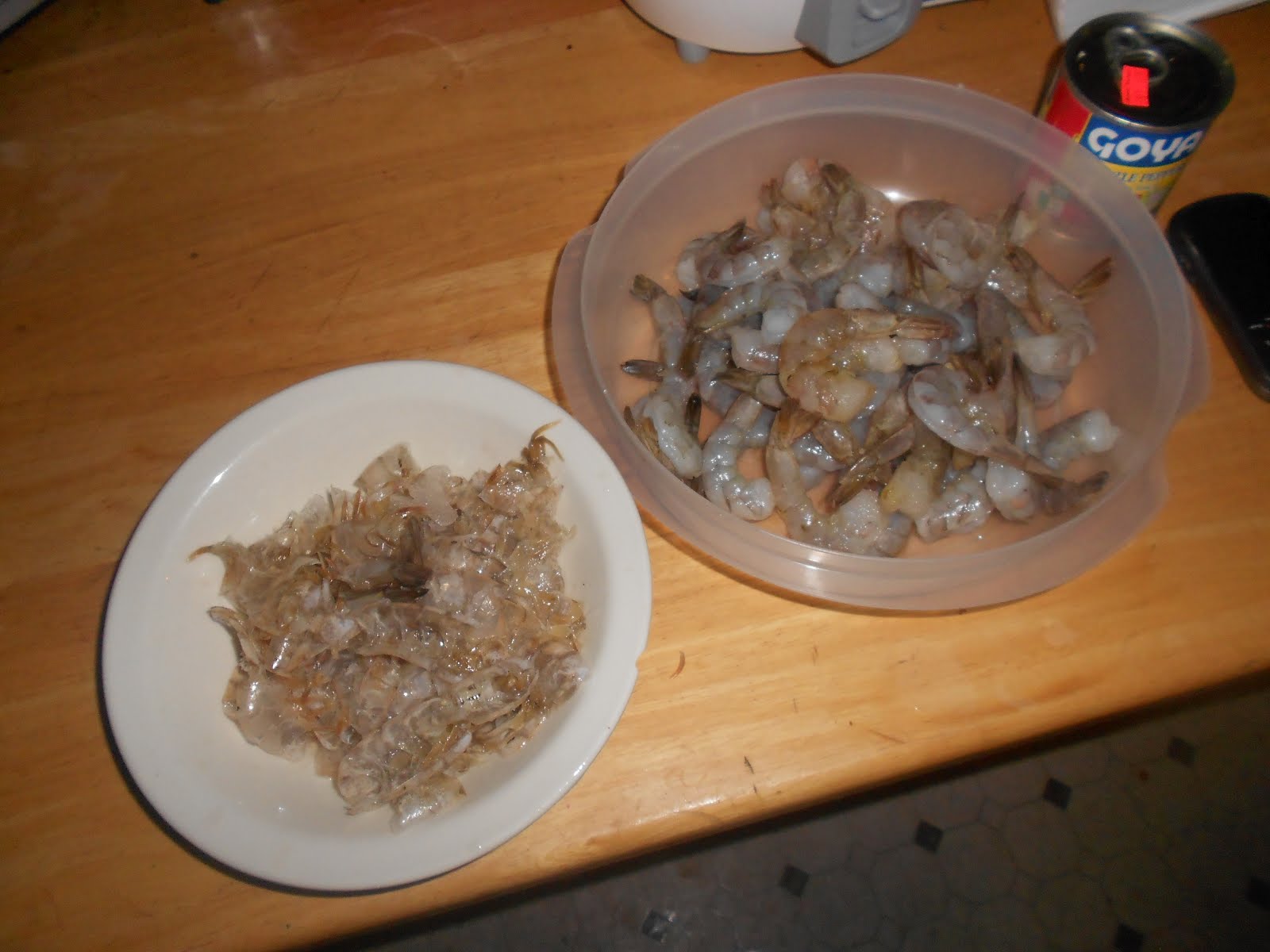
The peeled shrimps and their shells. I read somewhere that leaving the tails on promotes better cooking of the shrimp.
Should've used those shells to make stock for the broth but I just threw them out.


Blended sauce.


Sauteing garlic for the Nth time.


Cooking down the sauce a bit to concentrate the flavors.


Thinning out the resulting mixture with boxed chicken broth and cooking the shrimp.


Mmm, quite good and simple to put it off. I will definitely cook it again.
Joe A. was there and the recipe struck him as simple enough that he would want to cook the dish. When asked if he could help, I had him pick off the cilantro leaves.
However, I realize that every time I use fresh herbs I should practice chiffonading them.

Wednesday, April 25, 2012

Gumbo (CATKTVC)

So back last fall at some point, I decided to execute Jambalaya (CATKTVC) thinking for some reason that it was Gumbo. Perhaps I could blame this foolish mistake on the fact the former recipe wasn't accompanied by a photograph, but it's more likely that I really wasn't paying attention.
There's plenty of overlap between the two dishes when it comes to flavor profiles and ingredients, but jambalaya is a hearty rice dish and gumbo is a hearty stew or soup. Unsurprisingly, the process for each dish is quite different. Maybe I'll make jambalaya again someday and you can compare the two blog entries, but I don't remember particularly loving the dish. Do some damn research on your own if you're really curious!
  • 1 1/2 pounds small shrimp (51 to 60 per pound) [Sizing can vary wildly from brand to brand. One company's medium could very likely be another's small. Any good recipe will tell you the count per pound which is a much better, infinitely more consistent measure than ES/S/M/L/XL.] shells removed and reserved
  • 3 1/2 cups ice water
  • 1 (8-ounce) bottle clam juice
  • 1/2 cup vegetable oil
  • 1/2 cup all-purpose flour, preferably bleached [Eh, I only have unbleached]
  • 2 medium onions, minced
  • 1 medium red bell pepper, stemmed, seeded, and chopped fine
  • 1 medium celery rib, chopped fine [Yet another ingredient that failed to make it to my grocery list]
  • 6 medium garlic cloves, minced or pressed through a garlic press (about 2 tablespoons)
  • 1 teaspoon dried thyme
  • Table salt
  • Cayenne pepper
  • 2 bay leaves
  • 1 pound smoked sausage, such as andouille or kielbasa, sliced 1/4 inch thick
  • 1/2 cup fresh parsley leaves [If you've been thoroughly following my blog, you'll already know I don't believe there's much point in garnishing meals I usually only cook for myself]
  • 4 medium scallions, white and green parts, sliced thin [ditto]
  • Ground black pepper
Mise en place minus the clam juice still sitting in my pantry at this point.


I simmered shrimp shells in water for 20 minutes over medium-low heat to create stock.

Cooking a Cajun-style roux for the first time (I've made bechamel a few times in the past. Oh, to varying degrees of success.):

"Roux (play /ˈr/) is a cooking mixture of wheat flour and fat (traditionally butter). It is the thickening agent of three of the mother sauces of classical French cooking: sauce béchamel, sauce velouté and sauce espagnole. Clarified butter, vegetable oils, or lard are commonly used fats. It is used as a thickener for gravy, other sauces, soups and stews. It is typically made from equal parts of flour and fat by weight.[1] When used in Italian food, roux is traditionally equal parts of butter and flour. In Cajun cuisine, roux is almost always made with oil instead of butter and dark brown in color, which lends much richness of flavor, albeit, less thickening power. Hungarian cuisine uses lard (in its rendered form) or—more recently—vegetable oil instead of butter for the preparation of roux (which is called rántás in Hungarian)."

A Cajun-style roux involves constant stirring for about 20 minutes. There were a few seconds where I left the roux unattended to turn down the heat on the stock, consult with my copy of CATKTVC on the kitchen table all the way on the other side of the room, and set timers.
It didn't burn. I wasn't keeping track, but I'm also pretty sure it didn't take 20 minutes. I thank God on both counts, perhaps not literally.


Vegetables and spices stirred into the roux and cooked until softened.


What can I say? Me and spicy food go WAY back though occasionally I overdo it.
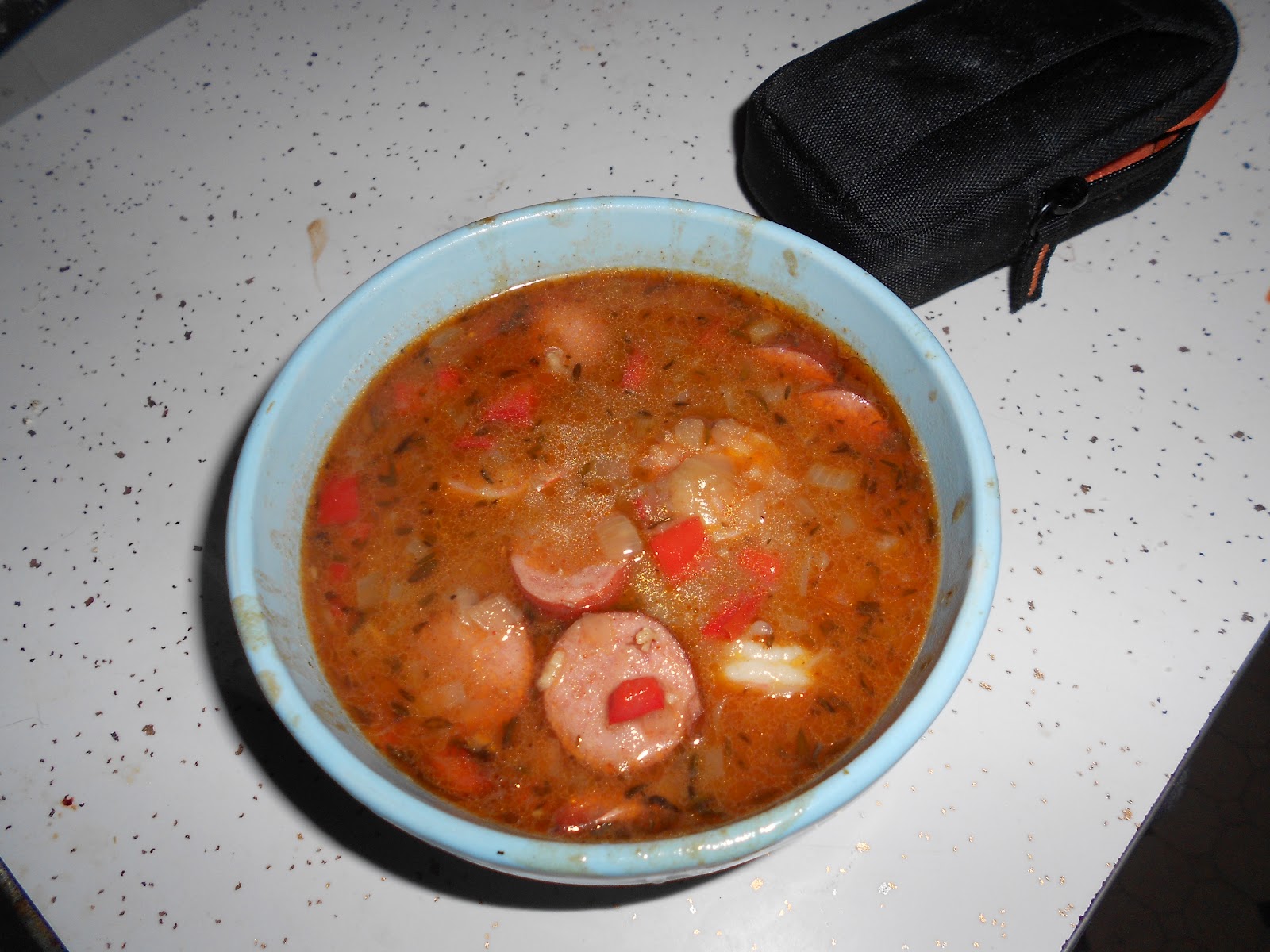
Was worried that would be the case here, but I successfully stayed on the edible side of the line.


Quite delicious. Jessica D, I'm pretty sure your boyfriend Junior would enjoy this rendition and not claim that it was way under-seasoned. I assume there are so many ways in which you aren't doing this right.