One-page prep and 2-page grocery lists written out before heading out to shop.
How else am I supposed to keep track of what I need to buy and what I need to do in what amount of time? The usual way of my mini-Rhodia notebook and "Hey! Just the cookbook." is not going to cut it here.

Prep list on its lonesome.
Ramen Broth
- 2 3-by-6-inch pieces konbu (Konbu certainly doesn't look 3-inches wide dried as I will later show you, but I think David Chang just wants you to use two pieces.)
- 6 quarts water
- 2 cups dried shitakes, rinsed
- 4 pounds chicken, either a whole bird or legs (I'm too lazy to practice breaking down a chicken every once and a while, so I went with the legs.)
- 5 pounds meaty pork bones
- 1 pound smokey bacon, preferably Benton's (Benton's is arguably the smokiest bacon on the market. Since I can't afford to be so exhaustively foodie as to purchase mail-order bacon, I used Savenor's Double-Smoked Bacon; still not cheap at $12.99 but much better than what I would have had to shell out for Benton's.)
- 1 bunch scallions
- 1 medium onion, cut in half
- 2 large carrots, peeled and roughly chopped
- Taré, preferably, or kosher salt, soy sauce, and mirin (I'll repeat here again that I didn't take the easy way out. A good thing since I let the broth over-reduce. Oh well.)

Mise en place.

As I mentioned earlier, I wasn't sure how much konbu to steep in the broth's initial step since the dried pieces were so narrow. Perhaps if I had thought about this through more I would have come to the conclusion to use 2 pieces instead of 4, but I did pull two out after they reached their unfurled state.
David Chang says that at Momofuku they use the konbu in dishes such as Grilled Octopus Salad, but honestly, I wasn't going to run out and buy Octopus and then execute that.

Simmering 2 cups of dried shitakes in the konbu-infused broth for 30 minutes. I'm perpetually led to ordering dishes with dried black mushrooms in Chinese restaurants, but I rarely cook with them. So sad.

Pork bones all laid out and ready to be popped in the oven.

30 minutes at 400 degrees F.

Bacon taking a bath in the broth that had been further infused with chicken legs for an hour. Once I ditched the bacon (after 45 minutes) and added the pork bones, I was finally able to escape the house and narrowly get to Blanchard's in time to pick up a bottle of sake in order to execute the taré while making the broth.
I would've been so pissed at myself if I hadn't been able to pick up that ingredient. Particularly since I had to be up until nearly 7 AM tending to the broth.

Adding the vegetables for the final 45 minutes.

Straining the broth through cheesecloth.

Strained broth, and OH YEAH, I get to go to bed now. Good night, Sun.
Yeah, I know I didn't get to five quarts. Should have been less stupid when it came to adding water.

The congealed fat on top of the broth when I eventually woke up Friday after. Probably not quite past 4 PM.

Yummers.

About 2 quarts when all was said and done. I'll later cut the broth with a quart of boxed chicken broth. I had to use ALL of the following taré recipe to make up for it, but I had enough broth for everyone that wanted ramen and a certain amount of leftovers.
Taré
"
The meaning of the term taré isn't consistent up and down Japan, but in Tokyo, where I learned about it, it is essentially Japanese barbecue sauce. At yakitori restaurants, places where they grill skewers of chicken over clean-burning bincho-tan charcoal, they brush the chicken with a slick of taré just as it finishes cooking. One of the coolest taré-making systems I've ever seen was at a yakitori joint in Japan where there was a channel underneath the grill funneling all the chicken drippings into a stone jar full of taré that was constantly being infused with grilled chicken drippings. (I imagined they replenished it with fresh soy, mirin, and sake the next day, boiled it, and returned it to its station.
"But in addition to its place of honor in the yakitori tradition, taré is the main seasoning--the primary 'salt' component--in ramen shops, at least in Tokyo. Ramenyas
have their own formulas for broth and their own recipes for taré. Broths are usually easy to figure out, because there's always a big pot bubbling away in plain view, with apples or leeks or whatever secret-ish ingredients a shop adds to it, but taré recipes are more mysterious because you rarely see them being made. Some places add dried scallops, others leave out the chicken bones.
"Ours is robust if simple, and it's a good way to put chicken trimmings or bones to use. Most ramen shops add the taré to the bowl when the soup is being assembled to be served, but that always struck me as a Russian roulette way of seasoning a soup--too much, too little, too easy to screw up. So we season our broth with it beforehand, tasting carefully with each addition to strike the right balance."
- 2 to 3 chicken backs, or the bones and their immediately attendant flesh and skin reserved from butchering 1 chicken (I picked up a pack of chicken bones at Savenor's and it was more than sufficient.)
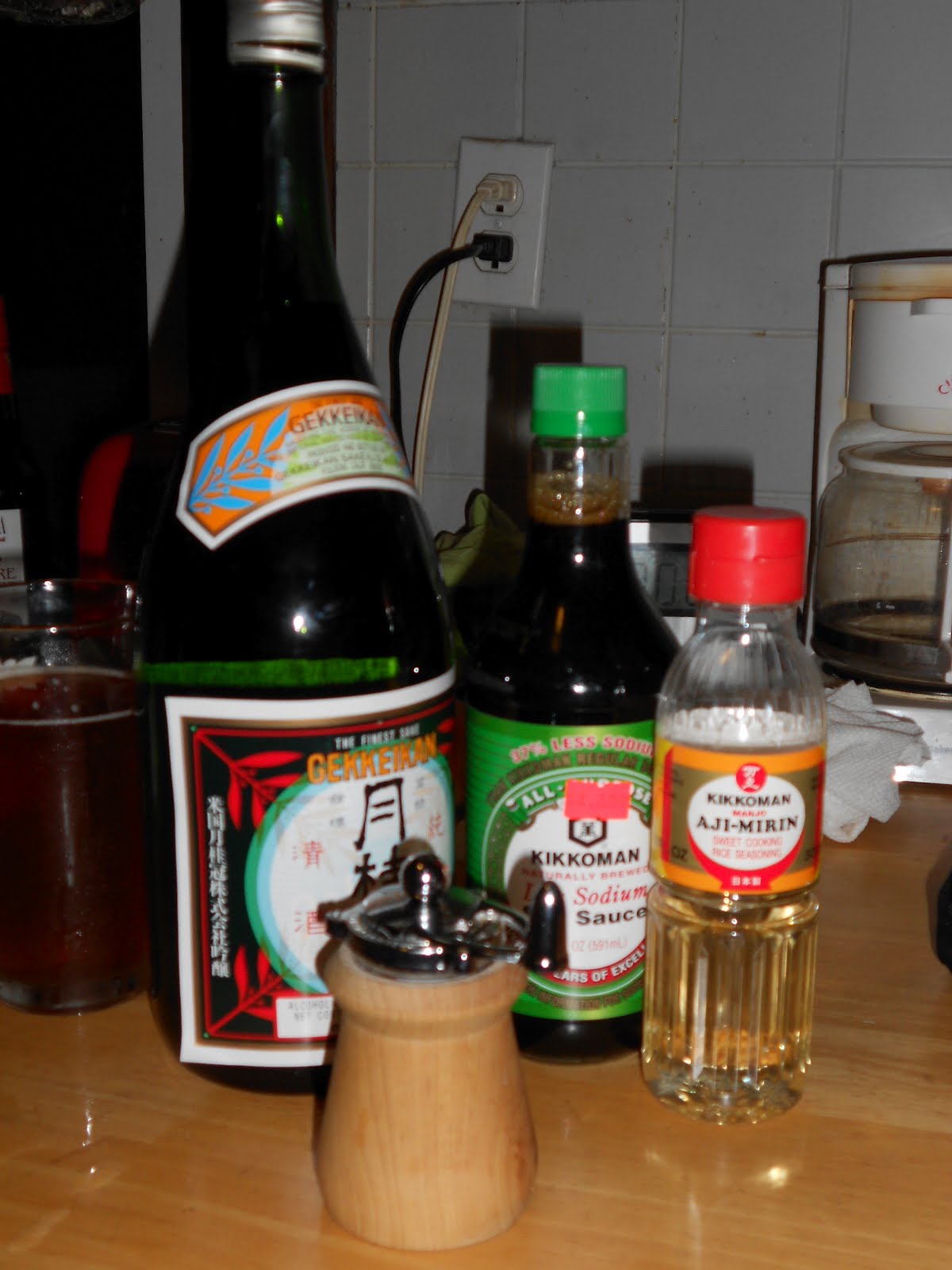
- 1 cup sake
- 1 cup mirin
- 2 cups usukuchi (light soy sauce)
- Freshly ground black pepper

First time I used the
Lodge Logic cast-iron pan I bought last fall.
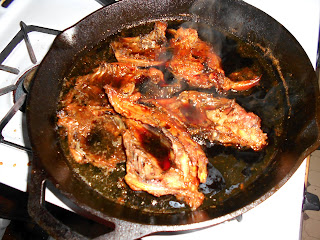
One hour at 450 degrees F.

Mise en place.

Simmered for 1 hour on the stove-top.
Light years better than soy sauce and mirin. Dontcha think?

Prep list after Day 1 execution.